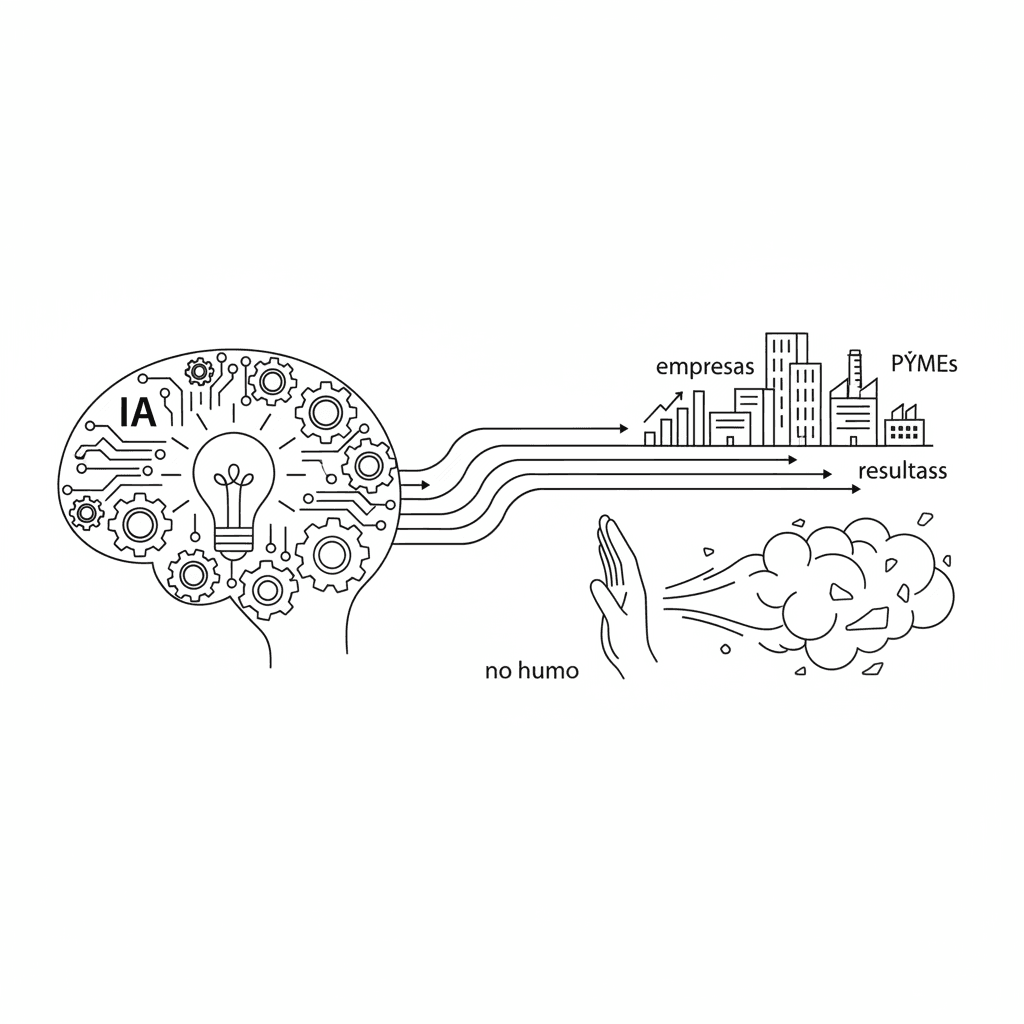
There are two very different conversations about artificial intelligence. The LinkedIn one, full of gurus and vague promises. And the one that really happens inside SMEs: one team member losing three hours a day answering emails, another copying data between Excel and the CRM, and the owner wondering whether all of this can be fixed without hiring five more people.
This article is about the second conversation. We’re going to talk about AI for businesses from the frontline: what works, what doesn’t, how much it costs, and which processes make sense to automate first when you’re billing between €500,000 and €20 million a year.
What “AI for businesses” really means in 2026
Forget ChatGPT for a moment. Artificial intelligence applied to business is not a chatbot you ask things to. It’s a layer of software that integrates with the tools you already use (your CRM, your email, your WhatsApp, your phone system, your ERP) and carries out specific tasks without anyone having to press a button.
The key difference compared with traditional automation is this: older workflows broke when something changed. If a customer wrote “invocie” with a typo or a PDF came in a different format, everything would fail. Today’s AI understands context, interprets natural language, and adapts. That changes the game for an SME, because for the first time it’s possible to automate processes that depend on language and judgment, not just fixed rules.
The processes where AI adds real value (and those where it doesn’t)
After implementing dozens of solutions in mid-sized companies, there’s a very clear pattern around where AI delivers fast returns and where it’s a waste of time.
Where it does work:
| Process | Typical result |
|---|---|
| Inbox management | From 3h to 15 min/day |
| Incoming lead qualification | Response in <60 seconds vs hours |
| After-hours phone support | 24/7 without the cost of missed calls |
| Sales proposal generation | From 1-2 days to 10 minutes |
| First-level support via chat or WhatsApp | 70-80% of queries resolved without a human |
| Synchronization between tools | Zero copying and pasting |
Where it doesn’t work (yet):
- Strategic decisions that require company-specific political context.
- Complex negotiations with large clients.
- Any process where the cost of an error would be catastrophic and there is no human oversight.
- High-level creative tasks (AI helps, but doesn’t replace).
The practical rule: if a task repeats more than 20 times a week and follows an identifiable pattern, there’s a 90% chance it can be automated with AI. If it’s unique every time, probably not.
How much it really costs to implement AI in an SME
This is where most articles become vague. Let’s be specific.
A well-built AI solution for an SME usually has three cost components:
- Initial design and implementation: between €2,000 and €15,000 depending on complexity. A voice agent for handling calls sits at the lower end. A full lead-qualification system with CRM and LinkedIn integration is at the higher end.
- Monthly operating cost: AI APIs (OpenAI, Anthropic, etc.) + infrastructure. For most SMEs, between €50 and €500 per month.
- Maintenance and improvement: because business processes change. This is usually a monthly retainer or billed by the hour.
To give you an idea of the return: if someone on your team spends 3 hours a day managing email and that drops to 15 minutes, you’re saving about 55 hours a month. At a company cost of €25/hour, that’s €1,375 a month. The initial investment pays for itself in a few months, and after that it’s profit.
How to choose where to start
The most common mistake we see: companies that want to automate everything at once. It doesn’t work. The right approach is to start with one painful, measurable, and contained process.
Ask yourself three things:
- What repetitive task is burning out someone on my team?
- How much time is lost each week on that task?
- What would happen if that task were done automatically, well, 24/7?
If you can answer all three with numbers, you’ve got your first use case. The rest will come later.
A real example: one of our B2B services clients was losing 4 hours a day managing incoming leads. We implemented a system that enriches each lead with LinkedIn data, qualifies it according to business criteria, and routes it to the right salesperson with a summary. Result: response time dropped from hours to under 60 seconds, response rate +35%, pipeline +22%. Implementation: 6 days.
The five mistakes that ruin AI projects in SMEs
- Buying software instead of solving a problem. There are thousands of “AI-powered” tools. Almost none fit your exact processes. Buying licenses without a clear plan is throwing money away.
- Wanting a “perfect” solution before launch. Better something working at 80% in 7 days than something at 100% in 6 months. AI improves by iterating with real data.
- Not measuring the baseline. If you don’t know how much time was being lost before, you won’t be able to prove the return afterwards.
- Getting locked into a closed provider. Working on open-source technologies (like n8n) gives you control and portability. Black boxes trap you.
- Ignoring the human factor. AI doesn’t replace the team; it frees them up. If the team doesn’t understand what the tool does and why, they’ll sabotage it (consciously or unconsciously).
Build in-house or outsource?
It depends on two variables: whether you have a technical team with free time (rare) and whether AI is part of your product or just an internal tool.
For most SMEs, building an internal AI team doesn’t make financial sense. A senior specialist engineer costs €60k-€90k a year, and you need at least two. Outsourcing to a studio that designs, implements, and maintains the solution is usually 5-10 times cheaper and much faster.
At Studio SmartWork we work this way precisely because we’ve seen it too many times: companies try to do it in-house, take months, and end up with something fragile that nobody knows how to maintain. Our model is different: you tell us the problem, we design the solution, we deploy it in under 7 days, and we keep it running while your business grows. No endless licenses, no dependency, no surprises.
What to expect over the next 12 months
AI applied to business is maturing quickly. Three things we see coming and that are worth keeping on your radar:
- Voice agents indistinguishable from humans for first-line phone support. They’re already here, and in 2026 they’ll be standard.
- Deep integration with WhatsApp Business as the main customer service and sales channel in Spain. Most SMEs are still not taking advantage of it.
- Automation of administrative processes (invoicing, reconciliation, reporting) that currently consume finance teams.
The opportunity window is now. Companies that implement AI well in the next 12-18 months will operate with very different cost structures from their competitors. And in SME margins, that makes the difference between growing and falling behind.
The question is not whether AI is going to change your business. It’s whether it will do so because you decided how, or because your competition decided it for you.